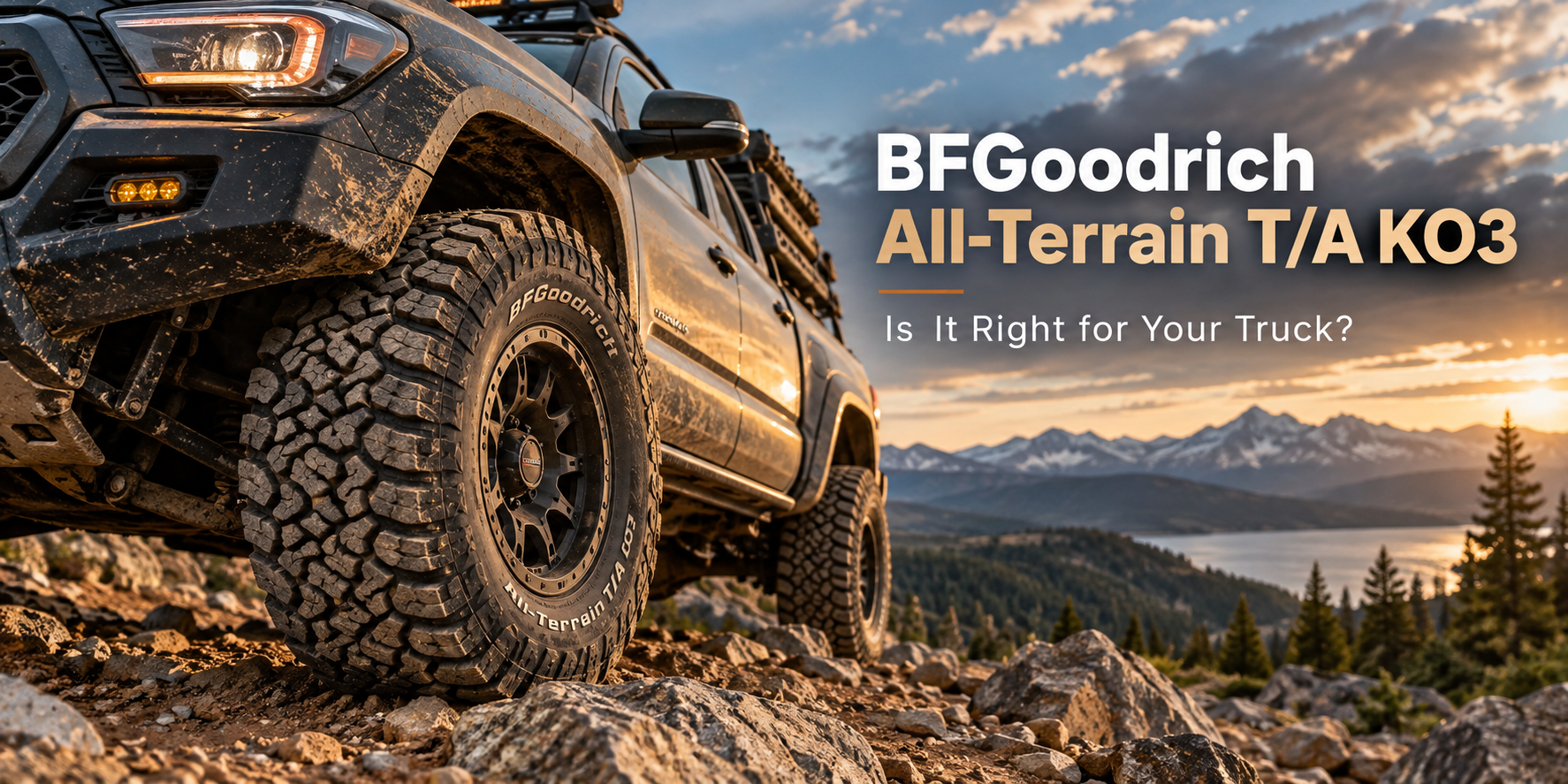
BFGoodrich All-Terrain T/A KO3: Is It Right for Your Truck?
The BFGoodrich All-Terrain T/A KO3 builds on one of the best-known all-terrain tire families with updated tread design, improved durability, severe-snow capability, and sizes for trucks and SUVs. Here’s what changed, how the KO3 is designed to perform, and what to consider before choosing it for your rig.
Some tire names become almost as recognizable as the trucks wearing them.
The BFGoodrich All-Terrain T/A is one of those names.
For decades, BFGoodrich has built the All-Terrain T/A line around the idea that one tire should be able to handle everyday pavement, dirt roads, trails, snow, gravel, and off-road use without forcing the driver into a dedicated mud-terrain setup.
The latest version is the BFGoodrich All-Terrain T/A KO3.
The KO3 replaces the long-running KO2 with a new tread compound, updated tread pattern, revised shoulder design, and additional durability-focused technology. It is still designed as an all-terrain tire rather than an extreme mud tire, which makes it especially interesting for trucks and SUVs that need to work both on and off pavement.
If you are comparing tires for your truck, Jeep, SUV, or overland build, you can browse the full BFGoodrich tire lineup at Elite Tires while you compare sizes and applications.
What Is the BFGoodrich All-Terrain T/A KO3?
The KO3 is BFGoodrich's current generation of the All-Terrain T/A family.
It is designed for drivers who want a tire that can handle regular road use while still providing meaningful traction and durability once pavement ends.
That puts it in the middle of the tire spectrum.
On one side are highway and touring tires that prioritize road comfort, quietness, and efficiency. On the other are aggressive mud-terrain tires built around maximum off-road traction.
The KO3 is designed to balance those worlds.
All-Terrain Instead of Mud-Terrain
An all-terrain tire uses larger and more aggressive tread blocks than a typical highway tire, but it generally keeps the tread more controlled than a dedicated mud-terrain tire.
That matters for drivers who still spend a large percentage of their time commuting, towing, road-tripping, or driving around town.
You get more capability off pavement without automatically accepting every tradeoff associated with a more extreme off-road tire.
Designed for Trucks, SUVs, and Crossovers
BFGoodrich offers the KO3 across a wide range of sizes for pickups, SUVs, 4x4s, and other vehicles that need additional all-terrain capability.
Elite Tires currently carries several KO3 configurations, ranging from LT truck sizes to larger off-road applications.
What Changed From the KO2 to the KO3?
The KO2 built a strong reputation over its production life, so BFGoodrich did not completely reinvent the concept.
Instead, the KO3 focuses on improving the areas that matter most to an all-terrain tire: tread life, gravel durability, traction, and sidewall protection.
Updated All-Terrain Tread Compound
The KO3 uses a new tread compound designed to improve durability on pavement and rough surfaces.
BFGoodrich says the updated compound helps the tire resist wear while still delivering the traction expected from an all-terrain design.
According to BFGoodrich's current product data, the KO3 delivers improved wear performance compared with the KO2, including better durability during gravel-road use.
Optimized Footprint
The tire's contact patch is designed to distribute stress more evenly across the tread.
Even pressure distribution can help reduce irregular wear, especially on heavier trucks where uneven loading can quickly become visible across the tread blocks.
This is particularly useful for vehicles that spend long periods on pavement before transitioning onto dirt or gravel roads.
Full-Depth Locking 3D Sipes
The KO3 also uses full-depth 3D locking sipes through the tread blocks.
Sipes are the smaller cuts inside the tread blocks. They create additional biting edges while allowing the block to remain stable under load.
Because the KO3's sipes extend deeper into the tread, their function is designed to remain relevant as the tire wears rather than disappearing quickly after the first part of the tread life.
How Is the KO3 Designed for Off-Road Durability?
All-terrain tires take abuse in ways ordinary road tires rarely experience.
Sharp rocks, gravel, roots, trail edges, potholes, and uneven surfaces can all impact the tread and sidewalls.
BFGoodrich built several protection features into the KO3 to address those conditions.
CoreGard Sidewall Technology
The KO3 uses BFGoodrich CoreGard technology, which draws from the company's off-road racing experience.
The sidewall compound is designed to resist splitting and bruising caused by impacts and trail debris.
For anyone who drives rocky trails or gravel roads, sidewall durability can be just as important as tread traction.
Advanced Deflection Design
The sidewall shape is also designed to help deflect objects that might otherwise catch or strike vulnerable areas of the tire.
No tire is puncture-proof, but a stronger and more carefully shaped sidewall can reduce the chance that every sharp rock becomes a problem.
Extended Shoulder Protection
The tread and shoulder structure extend farther down the sidewall than you would see on a conventional highway tire.
This adds additional rubber around an area that frequently contacts rocks and trail debris during off-road driving.
How Does the KO3 Handle Mud, Dirt, and Gravel?
The KO3 is not a dedicated mud tire, but BFGoodrich designed the tread to provide useful traction across mixed terrain.
Serrated Shoulder Blocks
The outer shoulder uses an aggressive serrated pattern to create additional biting edges.
These areas become especially important when the tire is working through loose dirt, mud, snow, or rutted terrain where the center tread alone may not have enough grip.
Mud-Phobic Bars
The tread also uses bars between portions of the tread blocks designed to help eject mud and debris.
Keeping the tread voids open allows the tire to continue finding traction instead of packing solid with material.
Interlocking Tread Elements
The center tread blocks use an interlocking layout intended to combine stability on pavement with biting edges off-road.
That balance is important because extremely flexible tread blocks can feel vague on the highway, while overly rigid tread designs may struggle to conform to loose surfaces.
Is the BFGoodrich KO3 Good in Snow?
One of the important changes with the KO3 is its severe-snow capability.
The tire carries the Three-Peak Mountain Snowflake symbol, commonly shortened to 3PMSF.
What Does 3PMSF Mean?
The Three-Peak Mountain Snowflake symbol indicates that the tire has met standardized performance requirements for acceleration traction in severe snow conditions.
That makes the KO3 more suitable for drivers who regularly encounter winter weather than a tire carrying only a basic all-season designation.
It Is Still Not a Dedicated Winter Tire
A severe-snow rating does not mean an all-terrain tire is identical to a true winter tire.
Dedicated winter tires use compounds and tread designs specifically optimized for freezing temperatures, packed snow, and ice.
If you regularly drive in severe winter conditions, particularly on ice, a dedicated winter tire may still be the better tool.
For drivers who want one all-terrain tire that can handle mixed conditions throughout the year, however, the KO3's snow rating adds meaningful versatility.
What Is the KO3 Like for Daily Driving?
Most trucks wearing all-terrain tires still spend the majority of their mileage on pavement.
That makes road behavior just as important as trail capability.
Road Stability
The interlocking tread blocks and optimized footprint are designed to keep the tread stable during everyday driving.
This helps the tire maintain predictable handling instead of feeling excessively soft or vague.
Noise and Comfort
Any aggressive all-terrain tread will generally produce more road presence than a quiet touring or highway tire.
The tradeoff is additional capability once you leave pavement.
Whether that tradeoff is worthwhile depends on your vehicle and how much off-road use you actually expect.
Fuel Economy
Larger and heavier all-terrain tires can also affect fuel economy compared with lighter highway tires.
The effect depends on tire size, tire weight, rolling resistance, inflation pressure, vehicle gearing, and driving habits.
Moving to a significantly larger KO3 may have a greater impact than replacing a factory tire with a similar-size KO3.
How Do You Choose the Right KO3 Size?
Choosing an all-terrain tire should start with the vehicle rather than the appearance you want.
Diameter, width, load rating, wheel size, suspension clearance, gearing, and intended use all matter.
Stay Close to Factory Size
For a daily-driven truck or SUV, staying relatively close to the factory tire diameter is often the simplest approach.
This helps preserve speedometer accuracy, gearing, suspension clearance, and overall drivability.
Going Larger
Larger tires can increase ground clearance and create a more aggressive stance, but the benefits come with tradeoffs.
A larger tire may weigh more, require additional clearance, affect acceleration and braking, change effective gearing, and create rubbing during steering or suspension compression.
Some setups may require suspension, wheel, or body modifications.
Check More Than Diameter
Two tires with similar overall diameter can still have very different widths and load characteristics.
Always consider the complete size rather than focusing only on the height.
What Do the KO3 Load Ratings Mean?
Many KO3 sizes are LT tires designed for heavier trucks and demanding applications.
That means load range and load index deserve just as much attention as tire diameter.
LT vs. Passenger Tire Construction
LT, or Light Truck, tires are designed around heavier loads and more demanding truck use.
They may have stronger construction than a comparable passenger tire, but that construction can also add weight and firmness.
The right choice depends on your vehicle's weight, towing requirements, payload, and intended use.
Do Not Automatically Choose the Highest Load Range
More load capacity is not automatically better if your vehicle does not need it.
An unnecessarily heavy tire can add unsprung and rotational mass while also changing ride quality.
Use the vehicle manufacturer's requirements and your actual load needs as the starting point.
Which KO3 Sizes Does Elite Tires Carry?
Elite Tires currently carries multiple BFGoodrich KO3 sizes, which makes it easier to match the tire to different truck and SUV setups.
For example, the BFGoodrich KO3 LT245/65R17 is one of the more moderate-size LT applications currently listed.
For larger truck setups, Elite Tires also carries the BFGoodrich KO3 LT315/70R17.
Drivers building around a traditional flotation size can also find the BFGoodrich KO3 35x12.50R15.
Those examples show just how different KO3 applications can be. They may all carry the same model name, but their dimensions, weight, load capacity, and vehicle requirements are very different.
Who Is the BFGoodrich KO3 Best For?
The KO3 makes the most sense for drivers who actually need an all-terrain tire's versatility.
Daily-Driven Trucks
If your truck is primarily driven on pavement but regularly sees dirt roads, job sites, trails, snow, campsites, or rough terrain, an all-terrain tire can provide additional capability without moving all the way to a mud-terrain design.
Overland and Adventure Builds
Overland vehicles regularly move between pavement, gravel, dirt, rocks, and unpredictable weather.
A tire built around mixed-surface durability fits naturally into that kind of use.
The KO3's snow rating can also be helpful for drivers who travel through changing climates during longer trips.
Work Trucks
Construction sites, farms, ranches, gravel roads, and remote work locations can be hard on ordinary highway tires.
The KO3's focus on gravel durability and sidewall protection makes it relevant for trucks that work off pavement rather than only looking the part.
Weekend Off-Road Vehicles
A Jeep or truck that spends weekdays on pavement and weekends exploring trails is exactly the kind of vehicle an all-terrain tire is designed around.
If the vehicle spends most of its time in deep mud or highly technical off-road terrain, however, a more aggressive tire may make more sense.
KO3 or Mud-Terrain Tire?
The answer depends on where the vehicle spends most of its time.
Choose an All-Terrain Tire When...
- The vehicle is driven on pavement regularly
- You want strong dirt and gravel capability
- You need useful snow performance
- You want more manageable road manners
- You occasionally tow or road-trip long distances
- Your off-road use is mixed rather than extreme
Consider a Mud-Terrain Tire When...
- Deep mud is a major part of your driving
- You regularly tackle highly technical trails
- Maximum loose-surface traction matters more than road comfort
- The vehicle spends limited time on highways
- You are willing to accept additional noise and other road-use tradeoffs
Neither design is automatically better. They are built for different priorities.
What Should You Check Before Ordering KO3 Tires?
Before buying any replacement tire, confirm more than just the wheel diameter.
Check:
- Factory tire size
- Wheel diameter and width
- Overall tire diameter
- Tire width
- Load index and load range
- Speed rating
- Suspension clearance
- Fender clearance
- Vehicle payload and towing requirements
- Recommended tire pressure
- Whether the vehicle is stock, lifted, or leveled
Do Not Buy by Appearance Alone
A 35-inch tire may look better to you than the stock size, but appearance should not be the only factor.
A tire that rubs, overloads the wheel, changes gearing excessively, or does not match the vehicle's load requirements is not an upgrade.
Plan the Wheel and Tire Together
If you are changing wheels at the same time, tire width and wheel width need to be compatible.
Offset and backspacing can also affect where the tire sits relative to the suspension and body.
Wheel and tire fitment should be treated as one system.
Is the BFGoodrich KO3 Worth Considering?
If you need one tire to handle daily driving, gravel, trails, changing weather, and occasional off-road use, the KO3 belongs on the shortlist.
It keeps the familiar all-terrain concept that made the KO line popular while adding updated tread technology, improved gravel durability, full-depth sipes, severe-snow certification, and revised sidewall protection.
That does not mean it is the perfect tire for every vehicle.
A highway-focused SUV may not need this much tread. A dedicated rock crawler or mud truck may need something more aggressive.
But for the huge middle ground of trucks and SUVs that genuinely live both on and off pavement, that balance is exactly the point.
Choose the Tire Around How You Actually Drive
The best tire is not necessarily the most aggressive one.
It is the tire that matches your vehicle, your terrain, your load requirements, and the way you use the truck every week.
The BFGoodrich KO3 is designed for drivers who want meaningful off-road capability without turning their daily driver into a dedicated trail rig.
If that describes your build, start by comparing the available sizes, load ratings, and fitment requirements before deciding which KO3 belongs on your truck.
Ready to compare options? Browse BFGoodrich at Elite Tires or view the full BFGoodrich tire collection to find the right size for your vehicle.